MATERIAL SAFETY DATA SHEET OF LIQUID AMMONIA (NH3):
1. IDENTIFICATION OF PRODUCT:
Ammonia, Liquid Ammonia, Anhydrous Ammonia. NH3
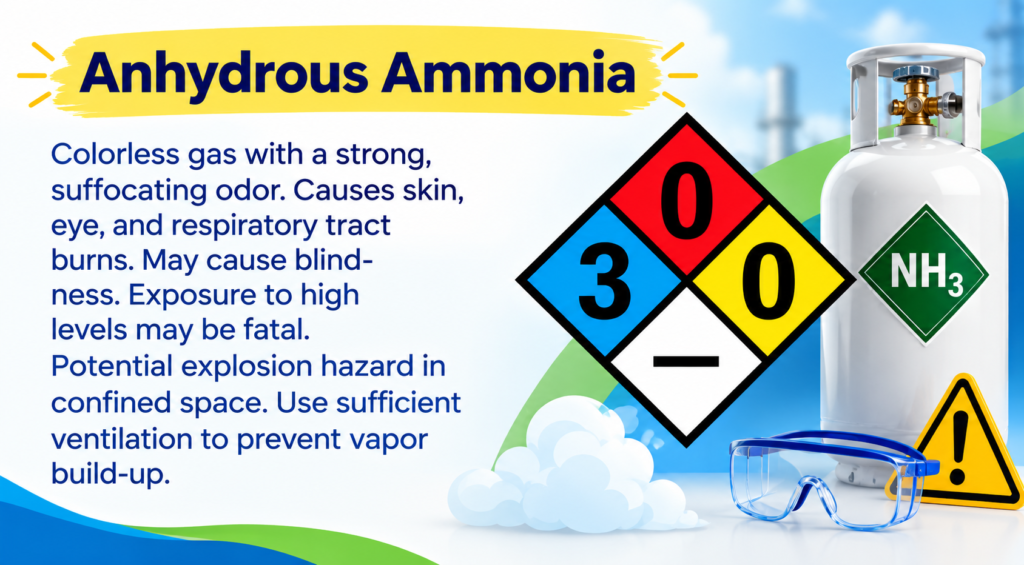
NFPA DIAMOND:
| RED: | Fire Hazard | 0 |
| YELLOW: | Reactivity | 0 |
| BLUE: | Health Hazard | 3 |
| WHITE: | Special Hazard | – |
General Information:
Essentially pure Ammonia containing minute levels of water (normally <3000 ppm)
2. COMPOSITION / COMPONENT INFORMATION:
General Characteristics of the Chemical Substances:
- Ammonia : >99.5 % by Weight
- Water: <3000 ppm by Weight
3. HAZARDS IDENTIFICATION. POTENTIAL HEALTH EFFECTS:
Ammonia is classed as Toxic according to EEC classification. Ammonia is toxic by inhalation, corrosive to all parts of the body and liquid splashes can cause serve cold burns.
3.1 Precautions: Avoid breathing – Avoid ingestion – Avoid Contact with eyes – Use by adequate ventilation
3.2 Over Exposure Conditions: Acute: unknown – Chronic: No evidence of adverse effects at exposure below occupational exposure limits.
3.3 Inhalation: Ammonia odor threshold 5-25 ppm. Concentrations in the range 50-100 ppm may cause slight irritation following prolonged exposure. Immediate eye, nose and throat irritation may occur with ammonia levels between 400-700 ppm with symptoms of slight upper respiratory tract irritation persisting beyond the period of exposure. At higher concentrations, above 1000 ppm, severe eye and upper respiratory tract irritation can develop following a short period of exposure. Exposure to ammonia in excess of 2000 ppm for even short periods may result in severe lung damage and could be fatal. Fluid buildup on the lung (pulmonary edema) may occur up to 48 hours after exposure and could prove fatal. – Exposure to concentrations grossly in excess of the occupational exposure limit may lead to permanent respiratory impairment.
3.4 Skin Contact: Liquid ammonia splashes may produce severe cold burns to skin. Vapor in presence of moisture is an irritant to the skin.
3.5 Eye Contact: Liquid ammonia splashes may cause permanent damage to eyes with the full effects not being apparent for several days. Vapor can cause irritation and watering of eyes and at high concentration can cause severe damage.
3.6 Ingestion: Will immediately damage to the gastro-intestinal tract.
3.7 Environment: Ammonia is toxic to aquatic life.
3.8 Fire, Heating & Explosion: Flammable but difficult to ignite in open air, in an enclosed space ammonia air mixture may be flammable /explosive. Danger of tank or cylinder bursting when heated. Large leaks of liquids ammonia may produce a dense cloud, restricting visibility.
4. FIRST AID:
NH3 is liquid product and product of high toxicity and basic. Speed is essential. Remove affected person from further exposure. Give immediate first aid and obtain medical attention.
4.1 Inhalation: Move the affected person to fresh air and provide oxygen if breathing is difficult. Treat symptomatically. Get medical Assistance promptly. Keep the patient warm and at rest. Apply artificial respiration, if breathing has stopped or shows sign of failing.
4.2 Skin Contact: Drench with large quantities of water. In case of frost bite (freeze burns) clothing may adhere to the skin. Defrost with care using comfortable warm water. -Remove clothing and wash affected parts. Obtain immediate medical attention.
4.3 Eye Contact: Immediately irrigate the eyes with eyewash solution or Flush with plenty of water at least for 15 min. Hold eyelids open during flushing. Continue irrigation until medical attention can be obtained.
4.4 Ingestion: If the person is conscious, wash out mouth with water and give 2 or 3 glasses of water to drink. Do not induce vomiting and seek for medical assistance. Do not leave the affected person alone.
4.5 Further Medical Treatment: Keep under medical review for possibility or rapid or delayed tracheal, bronchial and pulmonary edema. Progressive ocular damage may arise.
4.6 Specific First Aid Equipment: Availability of specific first aid equipment at the working place including flushing water and soap.
5.0 FIRE-FIGHTING MEASURES:
5.1 Appropriate Fire Fighting Resources: Ammonia vapour and liquid spills are difficult to ignite, particularly in the open air. In an enclosed space, mixtures of ammonia and air within the limits (16-27%), might cause explosion if ignited. Cold, dense cloud of ammonia may impair visibility.
5.2 Inappropriate Fire Fighting Resources: No data available.
5.3 Special Fire Fighting Protection: Personnel must be equipped with appropriate protective clothing and respiratory protection. Attempt to isolate source of leak. Use foam, dry powder or CO2. Use water sprays to cool fire-exposed containers and structures, to disperse vapors and to protect personnel. Do not spray water into liquid ammonia. Wear self-contained breathing apparatus and full protective clothing.
6.0 ACCIDENTAL RELEASE MEASURES:
6.1 Personal Protection: Those dealing with major releases should wear full protective clothing including respiratory protection.
6.2 Environmental Protection: Evacuate the area down-wind of the release, if it is safe to do so. If not, then stay indoors, close all windows and switch off any extraction fans or electrical fires. Isolate source of leak as quickly as possible by trained personnel. Ventilate area of spill or leak to disperse vapors. Remove ignition sources. Consider covering with foam to reduce evaporation.
6.3 Spillage Cleaning Procedure: Contain spillages if possible. Use water sprays to combat gas clouds. Do not apply water directly into large ammonia spills. Take care to avoid the contamination of watercourses. Inform appropriate authority in case of accidental contamination of watercourses or drains.
7.0 HANDLING AND STORAGE:
7.1 Handling: Avoid skin and eye contact and inhalation of vapors. Provide adequate ventilation. Control atmospheric levels in compliance with occupational exposure limits. Wear full protective equipment where there is a risk of leaks or splashes.
7.2 Storage: Store containers tightly closed in a cool and well-ventilated area. Keep away from heat, ignition sources and incompatible substances. (See Section10.3.). Do not permit smoking in the storage area. Follow appropriate Industry or National codes for bulk and container (cylinder) storage.
8.0 EXPOSURE CONTROL AND PERSONAL PROTECTION:
8.1 Exposure Control:
- TLV-TWA: 25ppm = 17mg/m3 ACGIH (Tab. 1995-96)
- TLV-STEL: 35ppm = 24mg/m3 ACGIH (Tab. 1995-96)
8.2 Personal Protection Measures:
Wear suitable breathing apparatus if exposure levels exceed the recommended limits. Wear PVC gloves, rubber boots, PVC suit. Use chemical safety goggles or full-face shield. Provide local exhaust ventilation where appropriate. Wear suitable breathing apparatus if exposure levels exceed the recommended limits. Wear cold insulating PVC gloves, rubber boots, PVC suit. Use chemical safety goggles or full-face shield.
9.0 PHYSICAL AND CHEMICAL PROPERTIES:
9.1 General Information:
- Appearance / Colour: Colourless gas at ambient temperatures.
- Odor: Pungent, suffocating.
9.2 Physical and Chemical Information:
- pH water solution (conc. 1%): 11.7
- Freezing Point: -77.7°C.
- Boiling Point: -33.4°C at 101.3 kPa
- LEL: 16%
- UEL: 25%
- Flammability: In the region of 16-27% NH3 by vol. in air at 0°C.
- Auto-ignition Temperature: 651°C
- Vapor Pressure: 1013 kPa at 25°C
- Relative Vapor Density: 0.6 (air = 1)
- Solubility in Water: Extremely Soluble, e.g. 529 g/l at 20°C
- Solubility in Organic Solvent: Soluble in Alcohol, Acetone and Chloroform
- Liquid Density: 0.6386 g/cm3 (at 0°C, 101.3 kPa)
- Gas Density: 0.7714 g/l (at 0°C, 101.3kPa)
10. STABILITY AND REACTIVITY:
10.1 Stability: Thermally stable in reaction terms at design storage conditions. Heat input can cause liquid to vapourise.
10.2 Condition to Avoid:
- Storage in warm place or in sunlight
- Physical damage and heating of containers
10.3 Materials to Avoid:
- Ammonia reacts violently with hypochlorite, mercury and halogens producing unstable compounds which are liable to explode.
- Attacks copper, zinc, aluminum, cadmium and their alloys.
- Reacts with mercury and silver oxide to form compounds that are sensitive to mechanical shock.
- Ammonia gas can react violently with nitrogen oxides and strong acids alloys
10.4 Hazardous Reactions and Decomposition Products:
- Contact with combustible material may cause fire. May assist combustion.
- May react violently with reducing agents, strong bases, organic materials, Chlorides and finally divided metals.
- Reaction with most common metals liberates hydrogen and toxic oxides of Nitrogen.
- Exothermic reaction with water.
- Corrosive gases/vapors.
11. TOXICOLOGICAL INFORMATION:
11.1 General: Ammonia is toxic by inhalation and corrosive to all parts of the body
11.2 Toxicity Data:
- Skin Contact: Vapour, in the presence of moisture, is an irritant to skin. Liquid splashes or vapour spray can cause chemical or freeze burns.
- Eye Contact: Low vapour concentrations can cause irritation and watering of eyes, higher concentrations (above 1000ppm) can cause severe damage. Liquid splashes may cause permanent damage with the full effects not being apparent for several days.
- Inhalation: Odour threshold 5ppm for some and 25ppm for most people. At 50-100ppm irritation experienced by most people. Depending on ammonia vapour concentrations, exposure may cause immediate eye, nose and throat irritation, coughing, difficulty in breathing. At high concentrations exposure, even for short periods, may result in severe lung damage. Pulmonary oedema may occur up to 48 hours after severe exposure and could prove fatal.
- EEC classification: Toxic
- EEC Toxic criterion for Gases and Vapours: Median Lethal Concentration 4 hour exposure: 500 to 2000mg/m3). Exposure to concentrations greatly in excess of the occupational exposure limit may lead to permanent respiratory impairment.
- Ingestion: Will immediately cause corrosion of and damage to gastro-intestinal tract.
- Other Data: No adverse effect has been evaluated by IARC as regards carcinogenicity. Ammonia is not mutagenic in Ames Salmonella test.
12. ECOLOGICAL INFORMATION:
12.1 Ecotoxicity: Free (non-ionized) ammonia in surface water is toxic to aquatic life, however the ammonium ion which predominates in most waters is not toxic. In the event of water contamination with ammonia, ammonium salts which may be formed will not present a toxic hazard. Increases in pH above 7.5 leads to an increased level of non-ionised ammonia.
- LC50 (96 hour) (various species) <1mg/l. Studies in fish have shown that repeated exposures produce adverse effects on growth rate at concentrations greater than 0.0024mg/l.
- EC50 (Daphnia magna) (48 hour) 24.4-189mg/l.
Other Harmful Effects:
- Depletion of Ozone Layer: No
- Creating of Photochemical Potential of Ozone Layer: No
- Possibility of Global Warming: No
12.2 Mobility: Very soluble in water. NH4+ ion is adsorbed by soil.
12.3 Persistence and degradability:
- In the soil, ammonia is quickly oxidized by microorganisms to nitrate ion.
- In fresh water, it may be nitrified by microorganisms or adsorbed on sediment particles and colloids. Substantially biodegradable in water.
- In the atmosphere, it may be degraded by photolysis or neutralised by acid pollutants of the air.
12.4 Bio Accumulation: Low potential
13. DISPOSAL CONSIDERATIONS:
Disposal should be in accordance with local or national legislation. For further advice contact manufacturer.
14. TRANSPORT INFORMATION:
14.1 UN Classification: Class 2 Gases, Division 2.3 Toxic Gas, UN No 1005.
14.2 Detail: ADR/RID, Class 2, Item 3¡(at), Label: 6.1. See Note 2. IMDG, Class 2 (2.3) , Label 2.3 + Label subsidiary risk 8 Gases, Division 2.3 Toxic Gas, UN No 1005.
15. REGULATORY INFORMATION
- EEC Directives: Classification and labelling according to Directive 67/548/EEC
- Toxic Hazard T: A skull and cross-bones
- Symbol: Risk Phrases: R10: Flammable. R23: Toxic by inhalation
- Safety Phrases:
- S7/9: Keep containers tightly closed and in a well-ventilated place.
- S16: Keep away from sources of ignition. No smoking.
- S38: In case of insufficient ventilation wear suitable respiratory equipment.
- S45: In case of accident or if you feel unwell, seek medical advice immediately (show the label where possible).
16. OTHER INFORMATION:
The information in this Safety Data Sheet is given in good faith and belief in its accuracy based on our knowledge of the substance/preparation concerned at the date of publication. It does not imply the acceptance of any legal liability or responsibility whatsoever by the Company for the consequences of its use or misuse in any particular circumstances.
16.1 Acronyms & References used in Preparation of MSDS:
- ACGIH: American Conference of Governmental Industrial Hygienists
- CAS No.: Chemical Abstracts Service. CAS Registration No. is an assigned number to identify a material.
- NIOSH: National Institute for occupational Safety and health
- NFPA: National Fire Protection Association
- NTP: National Toxicology Program
- OSHA: Occupational Safety and Health Administration
- PEL: Permissible Exposure Limit (OSHA)
- REL: Recommended Exposure Limit (OSHA)
- TLV: Threshold Limit Values (ACGIH)
- TWA: Time Weighted Average
Disclaimer: This information relates to the specific material designated and may not be valid for such material used in combination with any other product or in any process. Such information is to be the best of our knowledge and belief, accurate and reliable as of the data compiled. It is the user’s responsibility to use this information for their own specific purposes. We do not accept liability for any loss or damage that may occur, the use of this information nor do we offer warranty against patent infringement.